
What Does a Nail Tech Do? Career Guide 2026
- Bradenton Salon Today
- Jun 18
- 7 min read

A nail technician is a licensed beauty professional who performs specialized nail care services, including manicures, pedicures, nail enhancements, and artistic nail treatments. Understanding what does a nail tech do goes far beyond polish and pretty designs. The role demands technical precision, knowledge of product chemistry, strict sanitation protocols, and genuine client communication skills. Whether you are considering beauty school or simply curious about the profession, this guide breaks down every core responsibility, the daily workflow, licensing requirements, and the real challenges that come with the job.
What does a nail tech do every day?
A nail technician performs a defined set of nail care services that fall into four main categories: manicures, pedicures, nail enhancements, and nail art. Each category carries its own technical demands and time requirements.
Manicures and pedicures
A standard manicure covers nail shaping, cuticle care, hand exfoliation, moisturizing, and polish application. A pedicure extends those steps to the feet, adding callus removal and a longer soak. These are the foundation services every nail tech must master before moving to advanced work.

Nail enhancements
Enhancements include acrylic extensions, hard gel overlays, and dip powder systems like SNS. Each product uses a different chemistry. Acrylics rely on a liquid monomer and powder polymer that harden through polymerization. Gels cure under UV or LED light. Dip powders bond through a cyanoacrylate adhesive. Knowing the difference matters because improper application or removal causes nail damage and client injury.
Nail art and finishing
Nail art ranges from simple French tips to freehand painting, stamping, foil transfers, and 3D embellishments. Complex nail art can take 120 or more minutes per appointment. That time investment requires strong artistic skill and steady hands.
Sanitation and client screening
Every nail tech must screen clients before starting a service. Nail techs identify early signs of fungal infections, bacterial issues, and contraindications that make a service unsafe. Spotting a nail fungus or an open wound and referring the client to a physician is a professional duty, not optional. Proper sanitation means disinfecting tools between every client and following state board protocols without shortcuts.
Pro Tip: Keep a laminated sanitation checklist at your station. Visible protocols reassure clients and protect you from liability.
How is a nail tech’s workday structured?
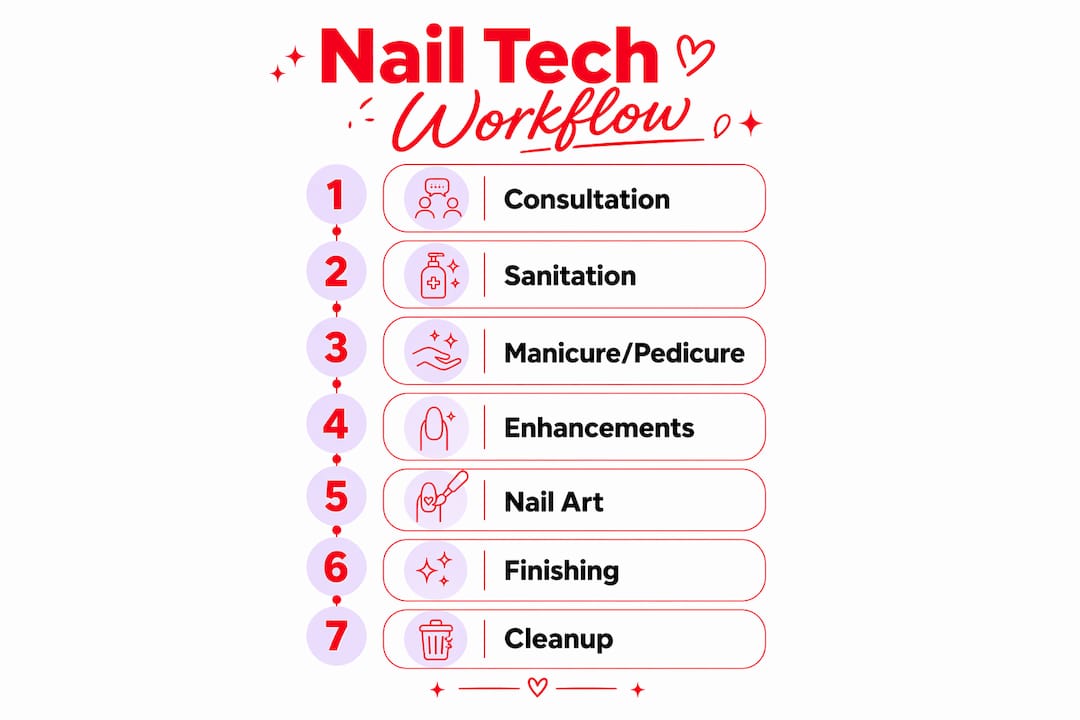
Nail technicians follow a mandatory 6-step sequence for every appointment: client consultation, sanitation setup, natural nail preparation, product application, artistic finishing, and post-service workstation disinfection. This structure is not optional. State boards require it, and skipping steps creates health risks.
Client load and appointment timing
Most nail techs see 6–10 clients per day. A basic manicure runs 30–45 minutes. Nail enhancements take 60–90 minutes. Complex nail art pushes past two hours. Scheduling those appointments without gaps or overlaps is a skill in itself.
Service Type | Estimated Time | Typical Daily Volume |
Basic manicure | 30–45 minutes | 4–6 clients |
Pedicure | 45–60 minutes | 3–5 clients |
Acrylic or gel enhancements | 60–90 minutes | 2–4 clients |
Complex nail art | 120+ minutes | 1–2 clients |
For a detailed breakdown of service timing by type, appointment planning becomes much easier when you understand how each service fits into a full workday.
Work outside direct client service
Independent nail techs and booth renters spend 20–30% of their work time on tasks outside direct service. That includes scheduling, inventory management, marketing, and client follow-up. A nail tech who works for a salon has most of that handled. One who rents a booth runs a small business. The distinction matters when you plan your career path.
Pro Tip: Block the last 30 minutes of your workday for restocking supplies and confirming next-day appointments. That habit alone prevents the scramble that kills your morning rhythm.
What education and licensing do nail techs need?
Nail technician licensing is required in every U.S. state, but the specific requirements vary significantly. Licensing scope differs by state, which affects which services you can legally perform and which school program you should choose.
Training hours and curriculum
Nail tech programs require 240–400+ training hours, compared to 1,000–1,500 hours for a full cosmetology license. That difference reflects the narrower scope of the nail tech license. Cosmetology covers skin, hair, and nails. A nail tech license covers nails only.
Typical nail tech curriculum includes:
Nail anatomy and physiology: Understanding the nail plate, nail bed, matrix, and surrounding skin structures
Product chemistry: How acrylics, gels, and dip powders work at a molecular level and why overexposure causes allergic reactions
Sanitation and infection control: State board standards for tool disinfection, sterilization, and client screening
Nail diseases and disorders: Identifying conditions like onychomycosis (nail fungus), paronychia, and psoriasis of the nail
Business and client communication: Consultation techniques, retail sales, and professional ethics
Practical application: Hands-on hours performing manicures, pedicures, and enhancements on real clients
Licensing exams
Most states require both a written theory exam and a practical skills exam. The practical portion tests your ability to perform services correctly under observation. Passing both earns your state license. Some states also require continuing education credits to renew that license every one to two years.
A nail tech license authorizes nail services only. If you want to offer facials or hair services, you need a separate esthetics or cosmetology license. Knowing that boundary before you enroll saves you from surprises later.
What are the real challenges of being a nail tech?
The nail technician career is rewarding, but it carries physical and professional demands that beauty school does not always emphasize. Going in with clear expectations makes you better prepared.
Physical demands and ergonomic risks
Repetitive motion and poor posture cause chronic pain in the neck, shoulders, wrists, and lower back. These injuries are common in nail techs who work long shifts without attention to body mechanics. An ergonomic chair with lumbar support and a properly adjusted table height are not luxuries. They are career protection.
Sit with your back straight and feet flat on the floor during every service
Position the client’s hand at elbow height to avoid hunching
Take a five-minute stretch break between every two clients
Use a dust mask and ventilation system when filing acrylics to reduce chemical inhalation
Chemical safety
Understanding chemical safety is non-negotiable for anyone working with acrylics and gels. Acrylic monomers can trigger occupational asthma and contact dermatitis with repeated overexposure. UV gel curing requires the correct lamp wavelength and cure time. Under-cured gel leaves unreacted monomers on the nail, which increases sensitization risk. Knowing your products at a chemical level protects both you and your clients.
Pro Tip: Always read the Safety Data Sheet (SDS) for every product you use. If your supplier does not provide one, choose a different supplier.
Client relationships and business skills
Client communication drives retention and earning potential as much as technical skill does. A nail tech who listens well, remembers client preferences, and follows up after appointments builds a loyal book faster than one who simply does good work in silence. For independent techs, that relationship-building is also a marketing strategy.
Key takeaways
A nail technician’s success depends on equal parts technical skill, health knowledge, and client relationship management.
Point | Details |
Core services | Nail techs perform manicures, pedicures, enhancements, and nail art as primary duties. |
Daily workflow | A mandatory 6-step sequence governs every appointment from consultation to workstation disinfection. |
Client load | Most nail techs see 6–10 clients daily, with service times ranging from 30 to 120+ minutes. |
Licensing requirement | All U.S. states require a nail tech license, earned after 240–400+ training hours and passing state exams. |
Career longevity | Ergonomic practice, chemical safety knowledge, and strong client communication protect both health and income. |
What being a nail tech really means
By MinhHieu
Most career guides describe nail technicians as people who paint nails and make hands look pretty. That framing undersells the profession by a wide margin. The nail techs I have seen build lasting careers treat every appointment as a health consultation first and an aesthetic service second. They notice the client whose nail plate has changed color since the last visit. They ask the right questions before picking up a file.
The creativity side of the job gets all the social media attention. The health and safety side is what actually defines professional competence. A nail tech who can execute stunning nail art but skips sanitation protocols is a liability. One who masters both is genuinely skilled.
The physical toll is also real and underestimated. I have watched talented techs leave the industry in their early thirties because they never invested in ergonomic equipment or learned proper body mechanics. That is a preventable loss. If you are entering this field, treat your body as part of your business infrastructure from day one.
The relationship side of the work is what keeps most nail techs in the profession long term. Regular clients become familiar faces. Appointments become conversations. That human connection is something no other beauty career quite replicates at the same frequency and intimacy. If you enjoy people as much as you enjoy craft, this career will hold your interest for decades.
— MinhHieu
Experience professional nail care at TJ nails in bradenton

Bradentonnails at TJ Nails in Bradenton, FL brings together skilled nail technicians, strict hygiene standards, and a full menu of manicure and pedicure services to give you a genuinely professional nail care experience. Every technician follows the sanitation protocols and technical sequences described in this guide. The salon offers classic manicures, gel and shellac finishes, acrylic and dip powder enhancements, nail art, and waxing services, all in a clean and welcoming environment. Bradentonnails is open seven days a week, including Sundays, making it easy to fit a quality appointment into your schedule. Book online today and see the difference that trained, licensed professionals make.
FAQ
What services does a nail technician perform?
A nail technician performs manicures, pedicures, nail enhancements such as acrylics, gels, and dip powders, and nail art. They also screen clients for nail infections and follow strict sanitation protocols between every appointment.
How many clients does a nail tech see per day?
Most nail technicians see 6–10 clients daily, depending on the service mix. Basic manicures take 30–45 minutes, while complex nail art can exceed two hours per client.
How long does it take to become a nail tech?
Nail tech programs require 240–400+ training hours depending on the state, followed by written and practical licensing exams. Most students complete their program in three to six months.
Can a nail tech perform hair or skin services?
No. A nail tech license covers nail services only. Performing hair or skin treatments requires a separate cosmetology or esthetics license, which demands significantly more training hours.
Is nail tech a physically demanding career?
Yes. Repetitive motion and poor posture cause common injuries in nail technicians, including wrist, shoulder, and back problems. Ergonomic equipment and proper body mechanics are critical for long-term career health.
Recommended
Comments