
Why Nail Salons Require Ventilation for Health and Safety
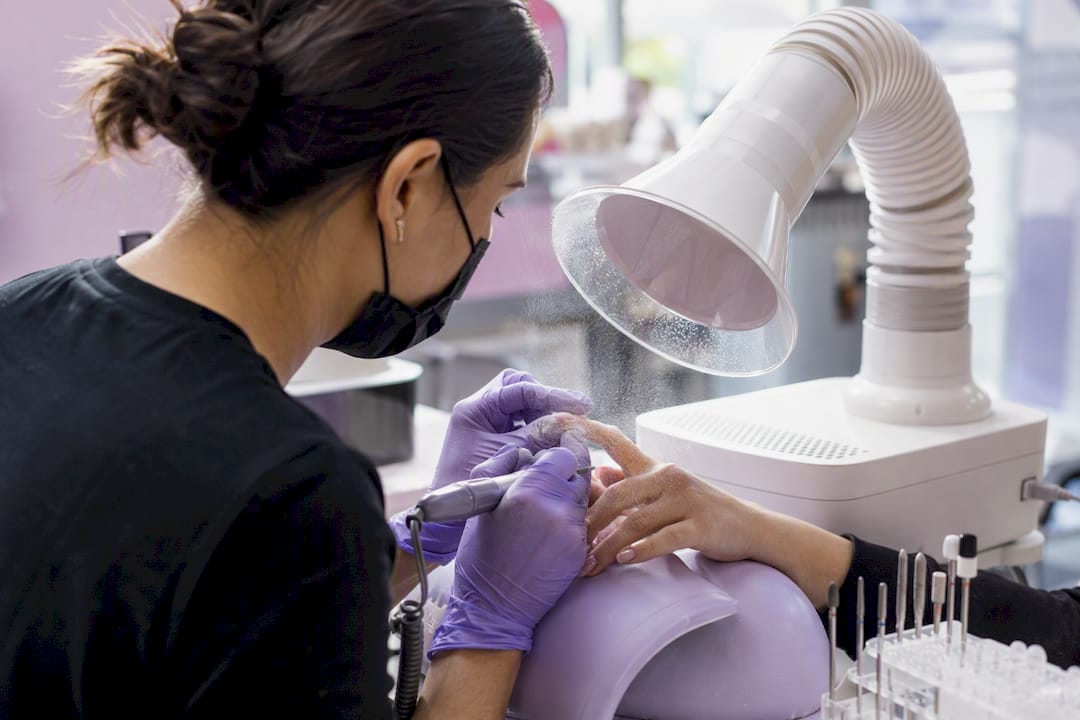
Nail salons require ventilation because acrylic dust and chemical vapors from polish, dip powder, and adhesive settle in the breathing zone of both technician and client unless something physically removes them. This isn’t a comfort issue. It’s an exposure-control issue, and the numbers back it up.
The National Institute for Occupational Safety and Health (NIOSH) has found that local exhaust ventilation (LEV) can cut worker chemical exposure by 50% or more in lab testing. Building codes back this with hard numbers, not suggestions.
The minimum source-capture exhaust rate required at each manicure and pedicure table under International Mechanical Code guidance is specified by building codes.
The outdoor air rate ASHRAE/ANSI ventilation standards recommend for general room air is specified by building codes.
Exhaust to outdoors only: recirculating salon air back into the room defeats the entire point
Key figure: NIOSH’s field testing found that adding local exhaust ventilation to an unventilated station cut airborne acetone by 77% and particulates by up to 90%.
Key Takeaways
Ventilation protects nail salon workers and clients by capturing VOCs and dust at the source, and code minimums like 50 CFM per station exist because dilution alone isn’t fast enough to prevent exposure.
Point | Details |
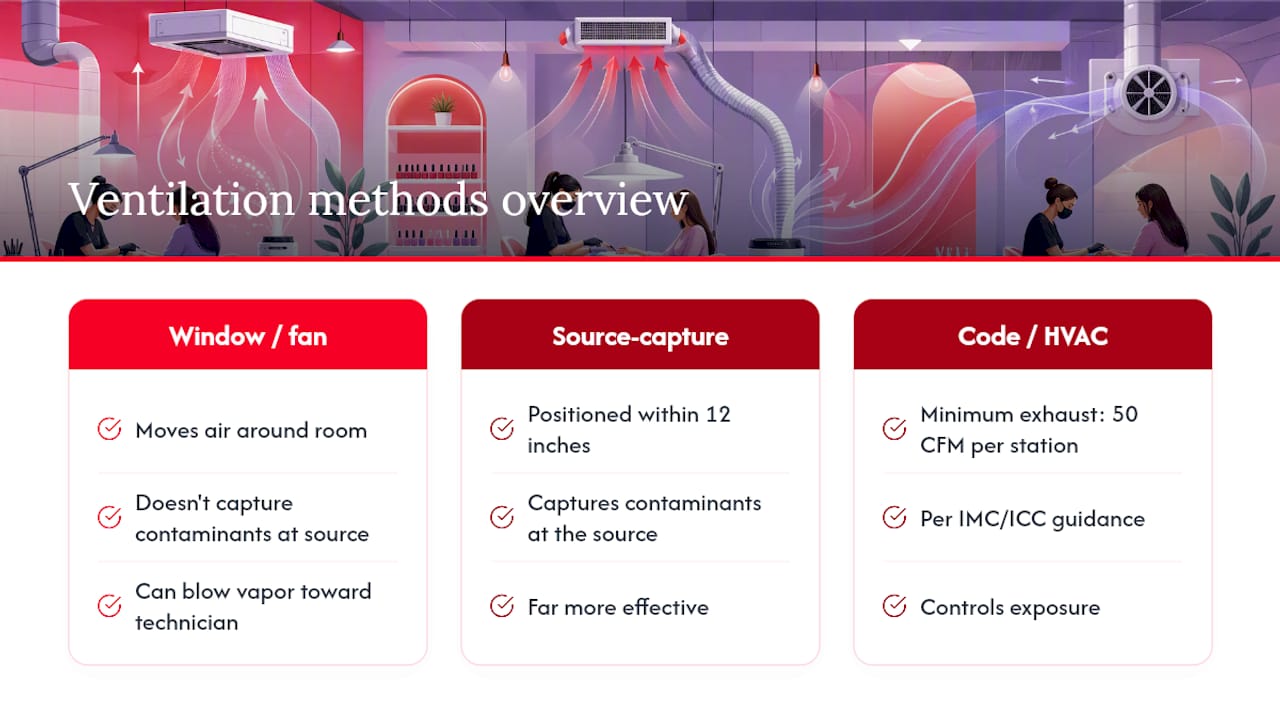
Source capture beats dilution | Capture hoods within 12 inches of the workstation intercept contaminants before they spread into the room. |
Codes set real numbers | IMC/ICC requires 50 CFM per station; ASHRAE/ANSI recommends 20 CFM outdoor air per person. |
LEV cuts exposure sharply | NIOSH testing found local exhaust ventilation reduced acetone by 77% and particulates by up to 90%. |
Owners carry the responsibility | Salon owners must install, run, and document maintenance of ventilation systems, not leave it to technicians. |
Clients can check quickly | Visible vents, running HVAC, and absence of strong chemical smell are reliable signs of a well-ventilated salon. |
Ready to experience a salon that takes air quality as seriously as nail art? Book a manicure appointment with Bradentonnails in Bradenton and see the difference proper ventilation makes, especially if you’re considering SNS dip powder services that generate more airborne dust than a standard polish change.
Table of Contents
What Health Risks Does Poor Nail Salon Ventilation Create?
The contaminant list in a working salon is longer than most clients realize. Acrylic and dip powder systems generate fine dust that lingers in the air long after filing stops. Polish, primer, and adhesive release volatile organic compounds (VOCs), including acetone, toluene, and in some cases formaldehyde, sometimes even in products marketed as “non-toxic.” Lab testing has found formaldehyde and toluene in polishes carrying that exact label.
Technicians who breathe this mixture for eight hours a day report headaches, eye and throat irritation, and lightheadedness as near-daily complaints. Peer-reviewed occupational health research ties longer-term salon exposure to respiratory irritation, asthma, and adverse reproductive outcomes, particularly among workers with years of cumulative exposure and no engineering controls in place.
The tasks that generate the most exposure are predictable:
Acrylic and dip powder application and removal (dust plus solvent vapor)
Polish and gel application, especially in poorly circulated rooms
Acetone soaking during removal, which releases concentrated vapor near the client’s face
A single chemical rarely explains a symptom on its own. It’s the mixture, breathed repeatedly, that adds up.
Is Source Capture Better Than General Ventilation?
Yes. Source capture pulls contaminants away at the point they’re created, before they spread into the room. General ventilation only dilutes air that’s already circulating, which means the technician and client have already inhaled a share of it by the time dilution catches up.
A capture hood positioned within 12 to 18 inches of the workstation, pulling at 50 CFM, intercepts dust and vapor before it reaches anyone’s face. A whole-room system supplying 20 CFM of outdoor air per person, by contrast, is working on air that’s already mixed throughout the salon.
Source capture: fast, localized, most effective when the inlet sits close to the hands
General ventilation: slower, room-wide, useful as a backup but not a substitute
Combined approach: what most compliant salons actually run
NIOSH’s testing demonstrates a large reduction effect when LEV is introduced at an unventilated station, and a separate pilot study in New York City salons found that optimizing existing systems can reduce TVOC levels by substantial percentages. Placement matters as much as horsepower. A fan moving huge volumes of air does nothing if the inlet sits two feet from the hands instead of six inches.
What Ventilation Standards Should Salons Meet?
Three numbers anchor most inspection conversations, and they come from three different authorities working in tandem.
50 CFM per station: minimum source-capture exhaust rate under IMC/ICC code guidance, with the capture inlet within 12 inches where a factory-installed hood isn’t present
Recommended outdoor air supply for general room ventilation is specified by ANSI/ASHRAE guidelines.
Exhaust termination distance: IMC guidance requires outdoor discharge points to sit well clear of property lines and building openings so vapor doesn’t re-enter through a window or intake
Exhaust air has to go outdoors, full stop, and the system needs periodic balancing to confirm it’s actually pulling the rated airflow rather than just running.
Before hiring a contractor or scheduling an inspection, ask three questions: What’s the measured CFM at each station? How close is the capture inlet to the work surface? Where does the exhaust actually terminate? OSHA’s guidance treats ventilation as the primary control for chemical exposure in salons, and NIOSH’s lab data is what those code minimums are built on.
What Does a Properly Ventilated Nail Station Look Like?
The most compliant setup pairs source capture at every station with a balanced HVAC system supplying filtered outdoor air, running continuously through business hours. Neither piece works well alone.
In practice, that means:
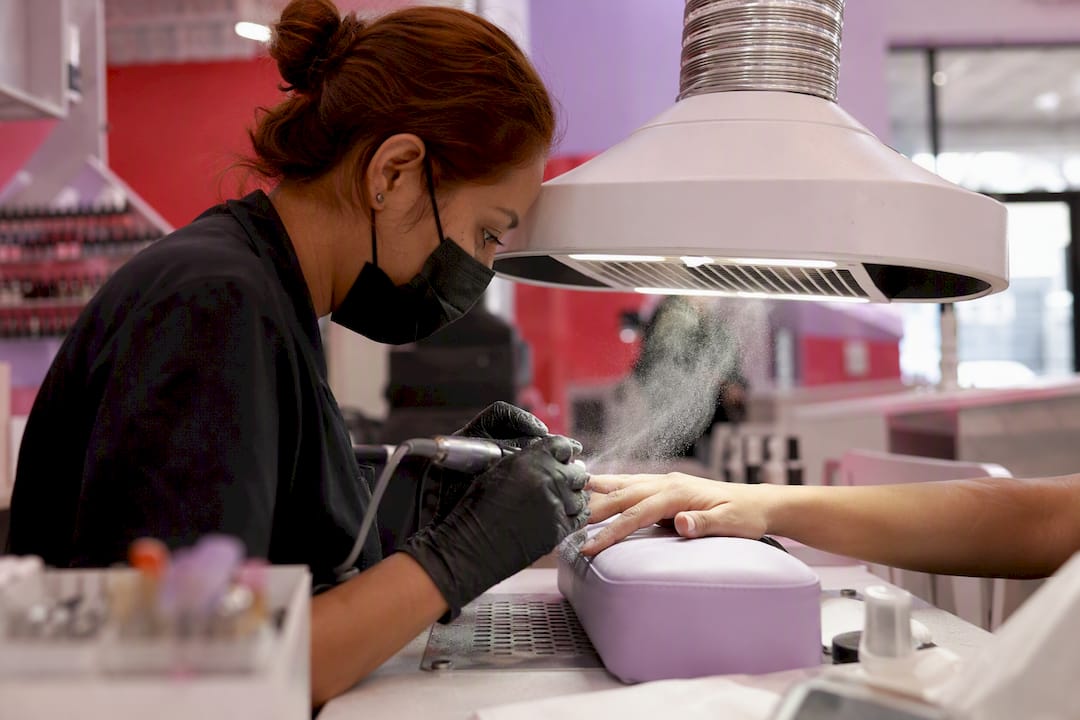
Ventilated manicure and pedicure tables with built-in exhaust ducted outdoors, not just a fan blowing air sideways
Portable LEV units at stations without built-in capture, positioned close enough to actually intercept dust and vapor
Dedicated exhaust fans ducted to an outdoor termination point, never vented into an attic or adjoining space
HVAC fan set to ON, not AUTO, during operating hours. AUTO cycles off once the thermostat is satisfied, which quietly kills air exchange for stretches of the day
Maintenance is where good systems slide into bad ones over time:
Charcoal or carbon filters: check and replace monthly
Catch basins and dust traps: clear weekly
HVAC filters: replace at least annually, more often in a high-volume salon
Full system balancing: have a professional verify airflow rates periodically, not just once at installation
Pro Tip: Keep every capture inlet within 12 inches of where hands actually rest. An open window or a box fan aimed across the table can push vapor toward the technician’s face instead of away from it. Distance and direction matter more than raw fan power.
Salons handling frequent acrylic removal generate more sustained dust and solvent exposure than polish-only stations, which makes consistent capture even more important there.
Who Is Responsible for Salon Ventilation and When Are Respirators Required?
The salon owner carries the responsibility for installing, running, and maintaining ventilation equipment, not the individual technician working at the table.
Owner duties include:
Verifying LEV and exhaust systems are actually operating, not just installed
Scheduling filter replacement and documenting when it happens
Bringing in an HVAC or ventilation contractor for periodic balance testing
Keeping maintenance and airflow-verification records on file for inspections
Ventilation reduces the need for routine respirator use, but it doesn’t eliminate every scenario. Under OSHA’s Respiratory Protection Standard (29 CFR 1910.134), a formal respirator program becomes necessary when engineering controls alone can’t keep exposures below permissible limits, and that program requires medical evaluation, fit testing, and staff training.
Keep documentation of filter changes, balancing reports, and any exposure assessments on hand. It’s the difference between a quick inspection and a drawn-out one.
What Should Salons Do This Week to Improve Ventilation?
Start with the checks that cost nothing but five minutes:
Confirm the HVAC fan is set to ON, not AUTO, for the full business day
Walk each station and verify the LEV unit is running and positioned within 12 inches of the work surface
Inspect and replace filters that are visibly clogged or overdue
Post a simple reminder near each station so staff double-check equipment before their first client
Over the next quarter, book a contractor to balance the system and verify actual CFM against the 50 CFM per station target. Confirm exhaust termination points still meet code distance requirements, especially after any remodeling nearby. Train new hires on why the fan stays on ON and document that training.
Pro Tip: Log daily operating hours for your ventilation system, even a simple checklist taped near the breaker panel. If a health inspector or an insurance auditor ever asks how consistently the system ran, a paper trail beats a memory.
This kind of routine discipline is part of the broader safety practices that separate a salon a client trusts from one they walk out of.
What Should Clients Look for When Choosing a Salon?
You don’t need technical training to spot good ventilation. Walk in and pay attention to what you smell and see.
Ventilated tables with a visible vent or hood near the work surface, actually running
No overwhelming chemical smell concentrated right at your chair
HVAC system audibly running, not silent and stagnant
Staff who can explain, without hesitation, how their ventilation setup works
A simple question like “Is your ventilation system running at every station?” tells you a lot from the answer alone. A salon confident in its setup will explain it without missing a beat. One that hesitates or changes the subject is worth reconsidering, alongside other cleanliness signals worth checking before you book.
How Do You Verify a Ventilation System Is Actually Working?
A handful of low-cost checks reveal whether air is truly being captured and exhausted, not just moved around.
Hold a strip of tissue paper near the capture inlet. If it doesn’t pull toward the vent, suction isn’t adequate.
Use a smoke pencil or smoke tube near the workstation to visually confirm airflow direction toward the hood rather than away from it.
Track whether chemical odor lingers minutes after a service ends. Persistent smell usually means the exhaust rate is too low or misplaced.
For a more precise read, a handheld TVOC or PID meter can give a rough concentration reading at the workstation.
Call in a professional if suction is undetectable at 12 inches, if odors persist well after ventilation is running, or if the system makes unusual noise suggesting a mechanical fault. A contractor can rebalance the ductwork and confirm the system actually hits its rated CFM instead of just running.
A Publisher’s Note on Ventilation and Trust
Good ventilation isn’t just a code requirement. It’s what a client notices in the first ten seconds of walking through the door, whether they can name it or not.
Bradentonnails treats running, maintained ventilation as inseparable from client comfort and technician health. It’s a legal obligation and a business advantage at the same time, and there’s no version of a well-run salon that skips it.
Frequently Asked Questions
Why do nail salons require ventilation by law? Nail salons require ventilation because acrylic dust and chemical vapors from polish, adhesive, and acetone concentrate in the breathing zone without a system to remove them. Building codes set minimum exhaust rates, typically 50 CFM per station under IMC/ICC guidance, specifically to control this exposure.
What happens if a nail salon has poor air circulation? Technicians and clients can experience headaches, eye and throat irritation, and lightheadedness after repeated exposure, and research links long-term exposure to respiratory irritation and other chronic effects. Poor circulation lets VOCs and dust linger far longer than they would with proper exhaust.
Is a window or ceiling fan enough ventilation for a nail salon? Usually not. An open window or a standard fan can move air around a room without capturing contaminants at the source, and it can sometimes blow vapor toward the technician rather than away. Source-capture systems positioned within 12 inches of the workstation are far more effective.
How often should nail salon ventilation filters be replaced? Charcoal filters typically need monthly attention, catch basins should be cleared weekly, and HVAC filters should be replaced at least annually, more often in a high-traffic salon. Documented replacement schedules also help during health inspections.
Do nail technicians need respirators if the salon has good ventilation? Good ventilation reduces the need for routine respirator use, but it isn’t a full substitute in every case. Under OSHA’s Respiratory Protection Standard, a formal respirator program becomes necessary when engineering controls alone can’t keep exposures below safe limits.
Sources
Recommended
Comments