
Why Salon Nails Outlast Home Polish: The Real Reasons

Professional gel manicures last 14–21 days, while home nail lacquer typically chips within 3–7 days. That gap is not about brand loyalty or expensive bottles. It comes down to controlled polymerization, professional surface preparation, and calibrated curing equipment that most home kits cannot replicate. Understanding why salon nails outlast home polish helps you make smarter choices about your nail care routine, whether you visit a salon weekly or rely on at-home touch-ups between appointments.
Why salon nails outlast home polish: the chemistry behind durability
Gel polish cures through polymerization, a chemical process that converts liquid monomers into a cross-linked molecular network. That network is both stronger and more flexible than the simple film left by conventional nail lacquer. Regular polish dries by solvent evaporation, which leaves a brittle coating that cracks under daily stress.
Professional salons use calibrated UV/LED lamps that deliver a specific wavelength and intensity to trigger full polymerization. Home lamps vary widely in output, which means gel layers may cure partially. Partial curing produces a weaker bond and a surface that lifts or peels within days.
Formulation also matters. Professional-grade gel products contain oligomers, photoinitiators, and plasticizers in precise ratios. Oligomers form the backbone of the cured film. Photoinitiators activate under UV/LED light. Plasticizers keep the cured gel flexible so it bends with the nail instead of snapping. Retail kits sold for home use often contain lower concentrations of these ingredients to reduce liability and cost.
Cross-linked polymer network: Creates a film that flexes without cracking under daily impact.
Calibrated curing lamps: Deliver the exact wavelength needed for full polymerization.
Professional formulations: Higher concentrations of oligomers and photoinitiators than most retail kits.
Apex placement: Technicians build a slight arch at the stress point of the nail to reinforce structural durability, a technique that is very difficult to replicate at home.
Pro Tip: If you use a home gel kit, hold your lamp over each nail for the full recommended cure time. Rushing this step is the single most common reason home gel lifts within the first week.
How environment and lifestyle affect manicure wear time
The chemistry of gel polish is only part of the story. Water exposure weakens any nail coating by causing the natural nail plate to expand and contract repeatedly. Each wet-dry cycle stresses the bond between the gel and the nail, eventually causing lifting or chipping at the free edge.
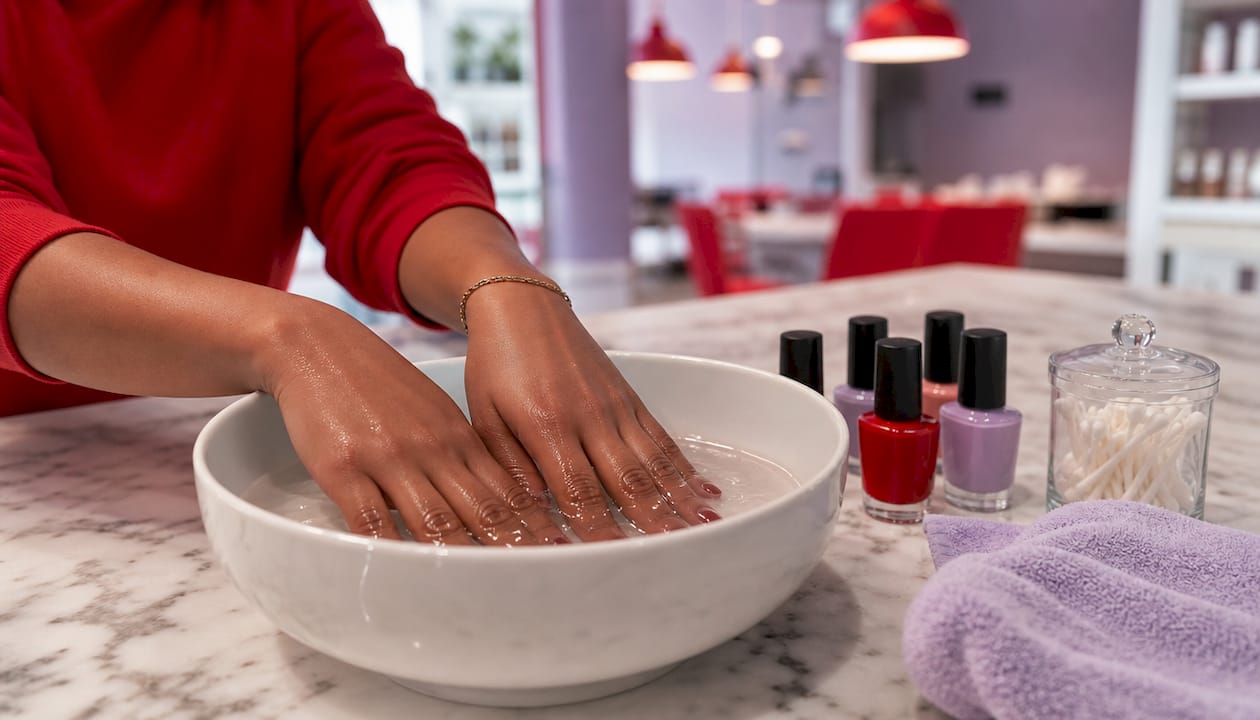
Lifestyle factors compound this effect. Clients who wash dishes without gloves, swim frequently, or work with their hands in water see noticeably shorter wear times regardless of whether their nails were done at a salon or at home. The nail plate itself expands when wet and contracts when dry. That mechanical movement is the primary cause of coating breakdown, not product failure.
Harsh chemicals accelerate the process further. Cleaning products, acetone-based hand sanitizers, and solvents break down the gel film from the outside. Nail health also plays a role. Dehydrated or thin nails flex more dramatically, which puts greater stress on the coating.
Wear rubber gloves when washing dishes or cleaning with chemical products.
Apply cuticle oil daily to keep the nail plate hydrated and reduce micro-flexing.
Avoid using nails as tools for opening packages or scraping surfaces.
Pat hands dry rather than rubbing, which reduces friction at the nail edges.
Pro Tip: Apply a thin layer of top coat over your gel every three to four days. It seals the free edge and adds a physical barrier against water and impact.
Your nail care routine between salon visits directly determines how close to 21 days your manicure actually lasts.
Why nail preparation and removal are critical for lasting results
Poor preparation is the leading cause of early gel lifting. Skipping nail cleansing or leaving dead skin on the nail plate interrupts the gel bond, even when the polish itself is high quality. Professional technicians follow a strict prep sequence that most clients never see but always benefit from.
The sequence starts with filing the nail surface to remove shine. This creates microscopic texture for the gel to grip. Next, a professional-grade dehydrator removes surface oils that would otherwise prevent the gel from bonding to the nail plate. Home applications almost always skip this step or use an inadequate substitute.
Cuticle work is equally important. Gel applied over lifted or overgrown cuticle skin will peel away from the base within days. Technicians push back and remove excess cuticle tissue before any product touches the nail.
Removal is where many clients unknowingly cause lasting damage. Aggressive or improper removal strips natural keratin layers from the nail plate, leading to thinning and brittleness over time. Peeling or picking gel off at home removes those keratin layers with it.
File the surface lightly to remove shine and create adhesion texture.
Apply a professional dehydrator to eliminate surface oils before any base coat.
Push back and trim cuticles so no skin overlaps the nail plate.
Apply thin, even layers of gel. Thin, evenly applied layers cure fully and last longer than thick applications.
Soak off gel properly using acetone-soaked cotton wrapped in foil, never peel or pick.
Allow nail breaks between gel sets to let the nail plate recover and rehydrate.
Safe removal is a skill in itself. Reading up on safe acrylic and gel removal before attempting it at home protects your nail health long-term.
Salon nails vs. home polish: time and cost compared
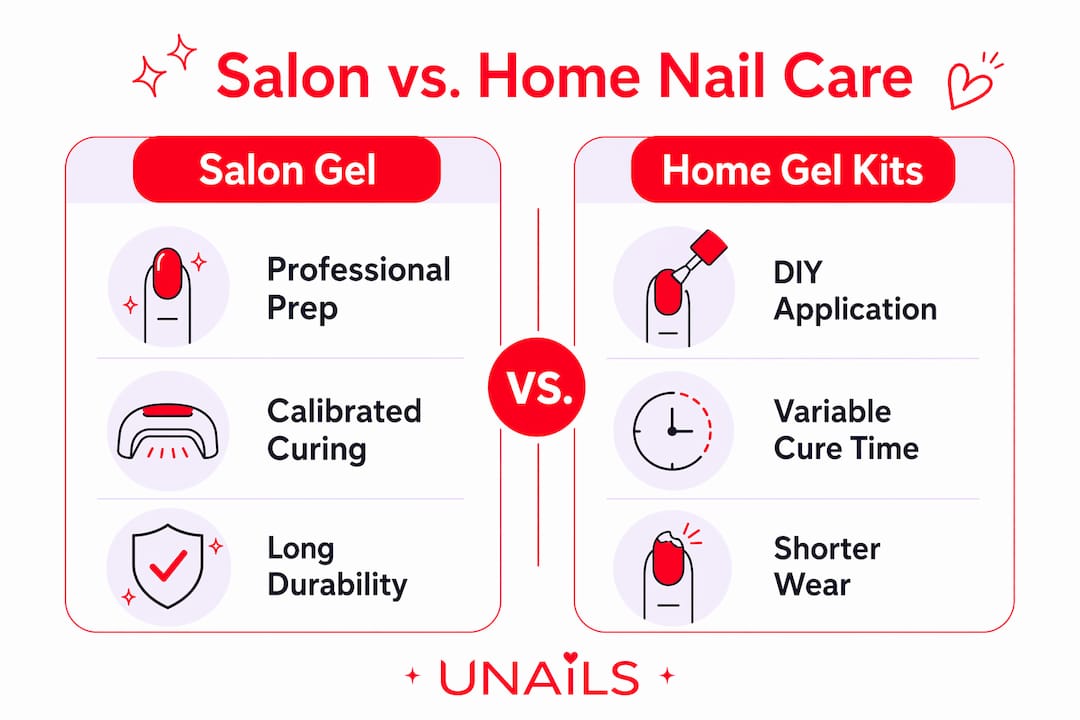
The cost comparison between salon visits and home kits is less straightforward than it first appears. Home gel kits cost $60–$150 upfront and require a learning curve before results match salon quality. Salon visits run $40–$100 per appointment, with a total time investment of 1.5–2.5 hours including travel.
The durability gap changes the math. A home manicure that lasts 5 days requires more frequent applications than a salon gel that holds for 18 days. Over a month, the time spent on repeated home applications often exceeds a single salon visit.
Factor | Salon gel manicure | Home gel kit |
Upfront cost | $40–$100 per visit | $60–$150 one-time |
Average wear time | 14–21 days | 5–10 days with practice |
Prep quality | Professional dehydration and cuticle work | Often incomplete |
Curing equipment | Calibrated UV/LED lamp | Variable output home lamp |
Removal safety | Technician-supervised soak-off | Risk of peeling and nail damage |
Professional nail care also reduces the risk of fungal infections. Professional tools and hygiene standards minimize fungal risks compared to unregulated home use. That health benefit adds long-term value that a price comparison alone does not capture.
Pro Tip: If you use home kits between salon visits, invest in a quality nail dehydrator and primer. These two products alone will extend your home manicure by several days.
Understanding the full time investment of a manicure helps you decide which approach fits your schedule and budget.
Key Takeaways
Salon nails outlast home polish because professional preparation, calibrated curing, and expert application techniques create chemical bonds that home kits cannot consistently replicate.
Point | Details |
Polymerization creates durability | Calibrated UV/LED curing forms cross-linked molecular networks far stronger than air-dried lacquer films. |
Prep determines adhesion | Professional dehydration removes surface oils that cause early lifting, a step most home applications skip. |
Lifestyle shortens wear time | Water exposure and chemical contact break down any coating faster, regardless of application quality. |
Removal protects nail health | Soaking off gel properly prevents keratin loss and keeps nails strong for the next application. |
Cost math favors salons long-term | Longer wear time reduces the frequency of applications, making salon visits cost-competitive over a month. |
What I’ve learned after years of watching clients choose between salon and home
The most common mistake I see is clients blaming the product when the real issue is technique. A client comes in with lifting gel after four days and assumes the polish was cheap. Nine times out of ten, the problem was residual oil on the nail plate or a home lamp that never fully cured the base coat.
Product quality matters, but it is the second variable, not the first. I have seen professional-grade gel applied poorly at home peel within a week. I have also seen a skilled technician get three weeks of wear from a mid-range product. The technique is the multiplier.
The clients who get the best long-term results are the ones who treat nail care as a routine, not a one-time fix. They come in for regular gel applications, follow a simple maintenance routine at home, and never peel their polish off. That last point is the one I repeat most often. Peeling gel removes the top layer of your natural nail every single time. Over months, that adds up to real thinning and sensitivity.
My honest advice: use home kits for touch-ups and color changes if you enjoy the process. But for longevity, nail health, and the kind of finish that holds up through a full week of real life, a professional application is worth the appointment.
— MinhHieu
Professional nail care at Bradentonnails in West Bradenton
Bradentonnails brings together skilled technicians, professional-grade products, and a clean, welcoming environment at its West Bradenton location.

Whether you want a classic gel manicure that holds for three weeks or a specialty SNS dipping powder set, the team at Bradentonnails applies the preparation and curing techniques that make the difference between polish that chips on day four and color that looks fresh on day eighteen. Flexible hours, including Sundays, make it easy to fit an appointment into a busy week. Book your next manicure at the Bradentonnails salon in Bradenton or visit the Bradentonnails homepage to see the full menu of services.
FAQ
Why does salon gel last longer than home polish?
Salon gel lasts longer because professional technicians use calibrated UV/LED lamps for full polymerization and apply a professional dehydrator before any product touches the nail. These two steps create a chemical bond that home applications rarely achieve consistently.
How long do salon nails actually last?
Professional gel manicures provide 14–21 days of intact wear. Home nail lacquer typically lasts 3–7 days, and home gel kits fall somewhere in between depending on preparation quality and curing equipment.
What is the biggest mistake people make with home gel kits?
Skipping the dehydration step is the most common cause of early lifting. Surface oils prevent the gel from bonding to the nail plate, and no amount of careful polish application fixes that underlying adhesion problem.
Does removing gel polish damage your nails?
Improper removal, specifically peeling or picking off gel, strips natural keratin layers and leads to thinning and brittleness over time. Soaking off gel with acetone-wrapped cotton prevents this damage.
Is a salon manicure worth the cost compared to home kits?
For most clients, yes. The longer wear time of 14–21 days versus 5–10 days for home kits means fewer applications per month, and the professional prep and removal protect nail health in ways that home kits typically do not.
Recommended
Comments